Of all the things that I’ve read in the last few years, the “three horizons” framework for thinking about the future from the International Futures Forum continues to be among the most influential pieces impacting my vision for the Next Education Workforce™ initiative. The concept is relatively straightforward and offers a simple way to think about how systems evolve:
- Horizon 1: The traditional system at present, “business as usual”; focused on stability and maintaining the status quo
- Horizon 2: Emerging activities and innovations that stretch or reconfigure what exists
- Horizon 3: A fundamentally different way of doing things, which is better fitted to the emerging world
I continue to come back to this work, largely through the thought leadership of Learner Studio and many others who have amplified and unpacked the three horizons.
Most U.S. schools today are operating in Horizon 1, with recurring schedules, single-teacher classrooms and siloed content instruction. There are a number of exciting innovations, pilots and emerging models that occupy Horizon 2, some with substantive scale. They offer valuable insights into what is possible within today’s constraints and often lay the groundwork for the infrastructure and systems needed to make Horizon 3 models viable. Models in Horizon 3 are currently far fewer in number and eschew many traditional aspects of schooling, such as age-graded instruction, seat-time-based learning and one-teacher, one-classroom staffing models. To borrow a sports analogy, these models serve as the best guesses as to where the educational “puck” is headed.
The world doesn’t move from the first horizon to the third horizon overnight. Undoubtedly, a multitude of factors — including policy, parent demand, economic conditions and technological advances — influence what proportion of students will experience each horizon. Figure 1 represents a possible depiction of change over time.
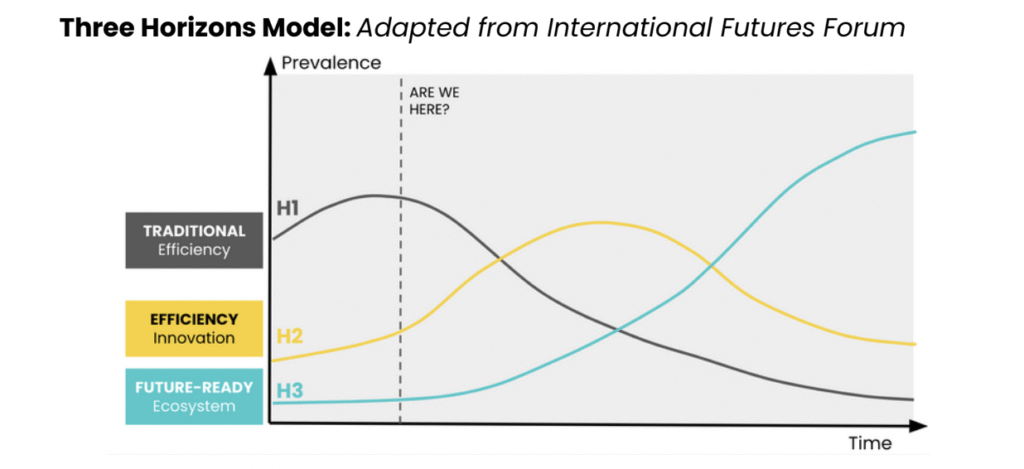
Source: LearnerStudio and Siegel Family Endowment
Next Education Workforce models as H2 innovations
We often describe Next Education Workforce models as a paradigm shift in how schools are staffed. Teams of educators with distributed expertise share responsibility for a common group of students: They plan together, flex time and space and ensure that every learner has access to multiple adults who know them well. While those features are early signs of a future-ready ecosystem (H3), our work still operates within today’s systems and policies. For that reason, I’ve long described our work as H2: innovation within the current system.
We can make a good case for elements of H3 already visible in our work. We talk about “educators” not just “teachers” and have crafted new roles, including lead teachers, literacy accelerators and community connectors. Educator teams recognize and value the distributed expertise of individual educators. We support school leaders to create the conditions where educator teams have autonomy to flex time and space dynamically to best meet student needs. Elementary teams are grouping and regrouping students throughout the day, week and unit. Some of our secondary teams have turned off the school bells, which allows the team to decide how to best use the instructional time.
And yet, H3 hasn’t quite felt like the horizon that captures where our work is today. Until recently, I couldn’t articulate why.
What would it take to move team-based staffing from H2 to H3?
A recent convening, The Educator Role in the Age of AI, cohosted by the Overdeck Family Foundation and NewSchools Venture Fund, helped crystallize what our work might look like in the third horizon. The answer, I realized, is probably less about the specific roles within a team and more about who configures the team. (See Footnote 1 at the bottom).
Currently, in Next Education Workforce models, schools put a shared group of students in the center and then build a team of educators with distributed expertise around them.
Are there students with specific learning differences? Is our goal to increase reading proficiency? How do we retain more 9th graders? Questions like these, rooted in community goals, student needs and educator expertise, guide how teams are organized to support each group of learners.
Imagine, however, a different approach, where we still had the same sorts of educators in the mix, but instead of the adults building the teams around students, the learners and their families build the teams. This shift from “student-centered” to “student-driven” is what might move team-based staffing into Horizon 3. Of course, there would need to be scaffolding, guardrails and some intentional continuity from earlier models. For example, older students would likely have greater autonomy in team creation, better learner record systems that would allow educators to more quickly and efficiently collaborate would be needed and care must be taken so that learning does not become so personalized that we lose the shared, common experiences that humanize schooling.
Realizing this vision will depend on building on the foundation we’re creating now. The Next Education Workforce initiative is, in exemplary H2 fashion, developing the infrastructure and mindsets that will make a learner-driven ecosystem more possible: new educator roles, skills and structures for educator collaboration, and the ability to dynamically adjust time, space and student groupings. These efforts strengthen today’s schools while laying the groundwork for what’s next. The real promise of Horizon 2 lies in its ability to bridge toward Horizon 3, empowering schools to redesign roles, schedules and collaboration structures in ways that both improve learning now and make a more student-driven future possible. them.
Footnote 1: Deep gratitude to all of the attendees at the The Educator Role in the Age of AI event, and special recognition to the small working group on the “Educator Role” where we batted around this idea. Specifically, I’d like to recognize: Anaiis Ballesteros, Habib Bangura, Jessica Fredston-Hermann, Bryan Hassel, Jin-Soo Huh, Albert Kim, Courtney Ochi, Stephanie Parra, and Pablo Torres. While the views of this piece are entirely mine, the thinking has been shaped by their collective brilliance. Thank you!